
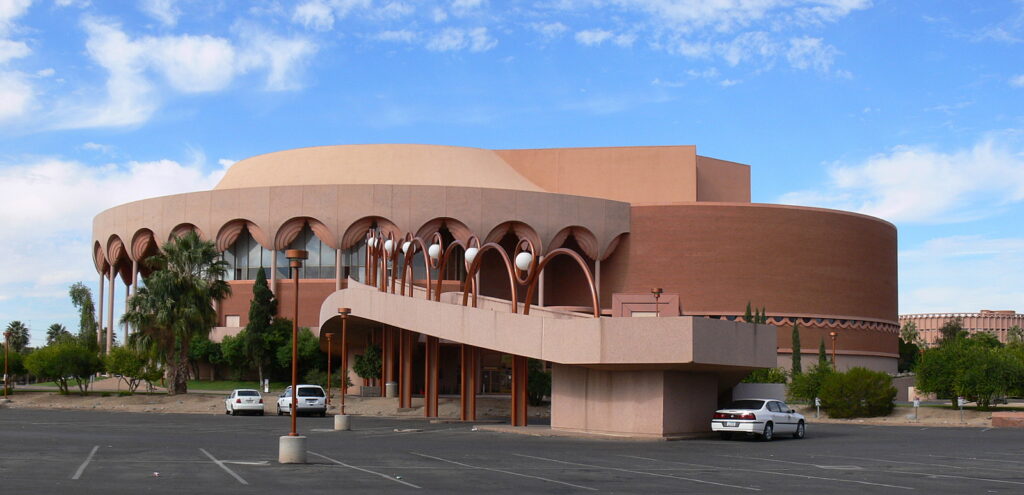
If you’ve ever driven past Arizona State University in Tempe, you’ve probably noticed one of the campus’s most distinctive landmarks: ASU Gammage, a massive circular auditorium with a striking architectural design. It is one of the final projects associated with legendary architect Frank Lloyd Wright, and its story is every bit as interesting as its appearance.
But before we explore Gammage, there’s a little campus nickname confusion worth clearing up. The neighboring ASU Music Building is officially known as the “birthday cake building.” Designed by William Wesley Peters, Wright’s son-in-law, this separate building sits near Gammage and is home to ASU’s School of Music. The two structures are easy to associate with one another, but they have different histories and architects.
A Friendship That Helped Shape an Arizona Landmark
The story of ASU Gammage begins with Grady Gammage, the president of what was then Arizona State College. In the 1950s, Gammage envisioned a major performing arts center that would serve the growing university and the wider community.
He turned to a friend he greatly admired: Frank Lloyd Wright.
The two men had developed a friendship, and Gammage believed Wright was the right person to create a building worthy of the university’s ambitions. Wright accepted the challenge, bringing an unusual opportunity with him.
From Baghdad to Tempe: A Design Finds a New Home
Wright’s design for the auditorium was not entirely new. He adapted plans originally developed for an opera house in Baghdad, Iraq, intended for King Faisal II.
That project never came to fruition. King Faisal II was assassinated in 1958, and the proposed opera house was abandoned. Wright’s design, however, found another possible home in Arizona.
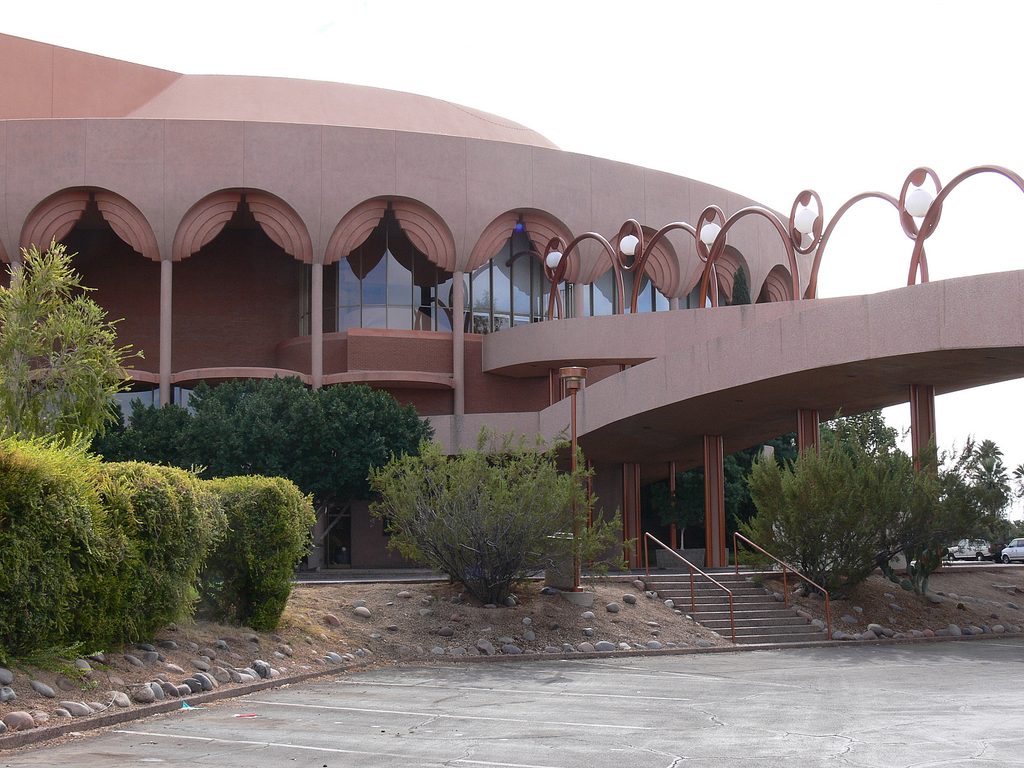
The result was a bold circular structure with sweeping forms and a distinctive exterior. It was an ambitious design for a university campus, and one that would become an architectural landmark in Tempe.
Building the Grady Gammage Memorial Auditorium
Construction took place between 1962 and 1964, under the direction of architect William Wesley Peters, who helped bring Wright’s vision to life.
Sadly, neither Grady Gammage nor Frank Lloyd Wright lived to see the finished auditorium. Gammage died in 1959, and Wright passed away in 1959 as well.
The building was completed and opened on September 18, 1964. Its opening-night performance featured the Philadelphia Orchestra. Later that year, Camelot became the auditorium’s first Broadway production.
Originally named the Grady Gammage Memorial Auditorium, the venue eventually became known as ASU Gammage.
An Auditorium Built for Big Performances
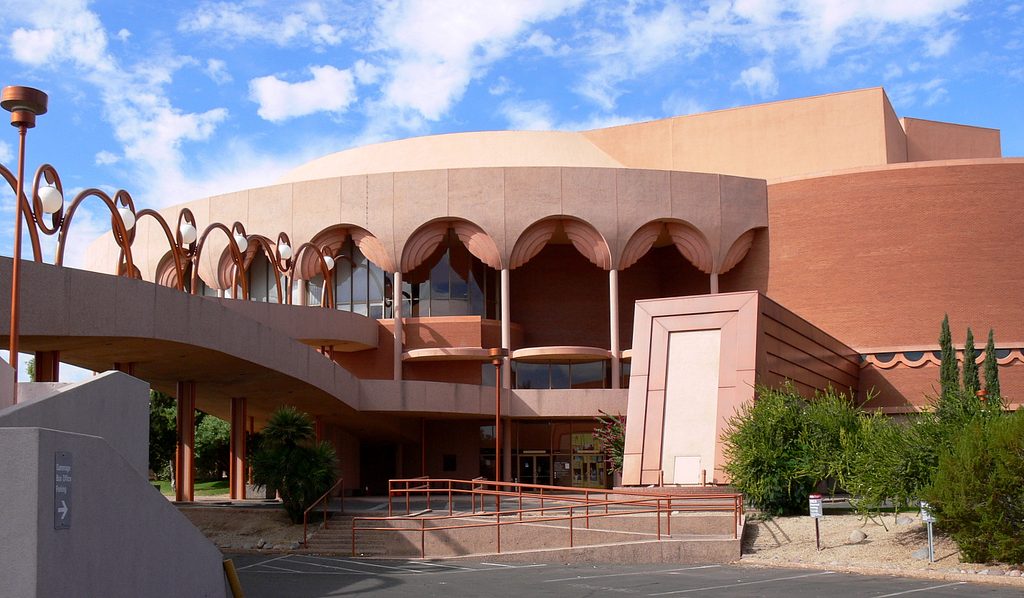
ASU Gammage was designed to accommodate approximately 3,017 people, making it one of the major performing arts venues in Arizona.
Over the decades, it has welcomed Broadway productions, concerts, performers, speakers, and other special events. Its stage has hosted an impressive range of entertainment and cultural experiences, helping establish the auditorium as an important part of Arizona’s arts community.
The building has also served as a setting for significant public occasions. Among them were the funeral of Arizona Senator Barry Goldwater and the 2004 presidential debate between George W. Bush and John Kerry.
In other words, Gammage has seen far more than opening-night curtains and standing ovations!
A Neighboring Building with Its Own Birthday Cake Nickname
While Gammage is the work of Frank Lloyd Wright, its nearby neighbor has a design story of its own.
The ASU Music Building was designed by William Wesley Peters and completed in 1970. Peters was Wright’s son-in-law and had a close professional connection to the architect’s work.
The building is home to ASU’s School of Music, with classrooms, practice rooms, recital halls, and performance spaces. It is also affectionately known as the “birthday cake building.”
The structure has eight levels, including three below ground, giving it five above-ground levels. Its distinctive shape and location near Gammage make the two buildings an interesting architectural pairing on the Tempe campus.
It’s a small but worthwhile distinction—and a good reminder that even familiar landmarks can have stories hiding right next door.
A Lasting Part of Arizona’s Architectural History
ASU Gammage was added to the National Register of Historic Places in 1985, recognizing its architectural and historical significance.
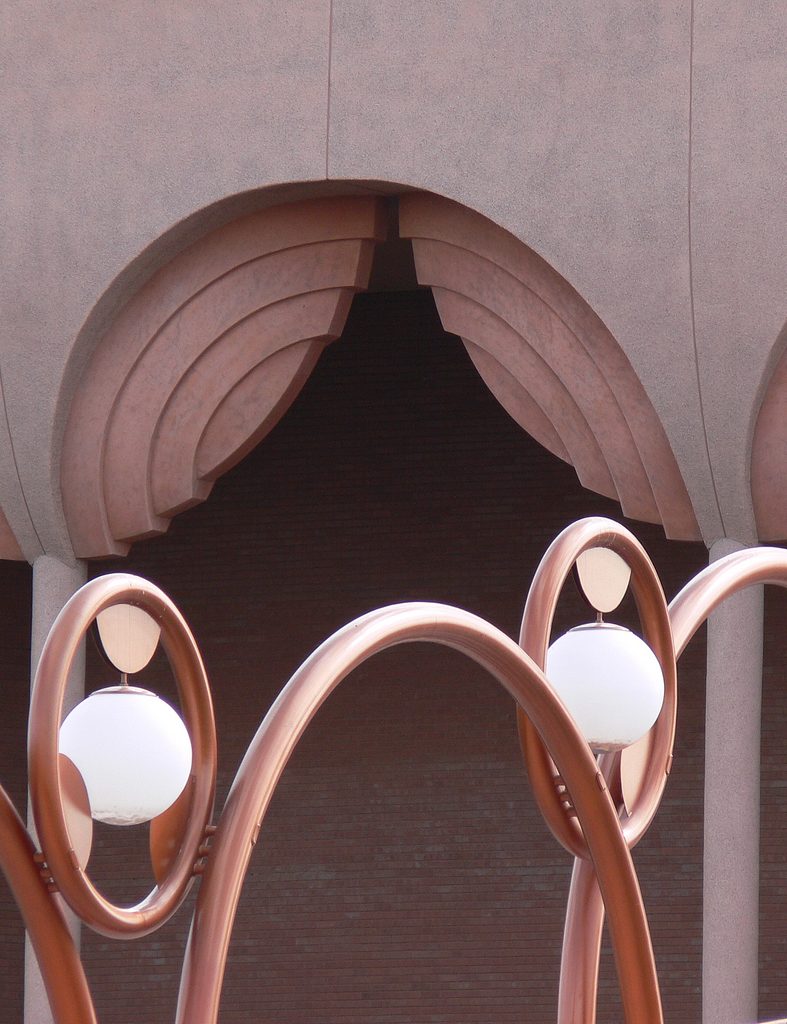
Today, it remains one of the most recognizable buildings in Tempe and an enduring example of Frank Lloyd Wright’s influence on Arizona architecture. Its unusual design, connection to an unrealized project in Baghdad, and the friendship that helped bring it to Arizona make it much more than just another university auditorium.
The next time you’re passing through the ASU campus, take a closer look. Gammage and the neighboring Music Building each have their own architectural identity—and together they make for a pretty interesting stop in Arizona’s story.
Stay Curious.
Photo Credits = Wars, CC BY-SA 2.0 DE, via Wikimedia Commons

Learn More
- ASU Gammage — Official Website
- ASU Gammage History and 60-Year Timeline
- Frank Lloyd Wright Foundation — Grady Gammage Memorial Auditorium
- City of Tempe — Grady Gammage Memorial Auditorium
Curious Perro explores the history, culture, and unusual stories behind the places that make Arizona, Texas, and the wider world worth discovering.