
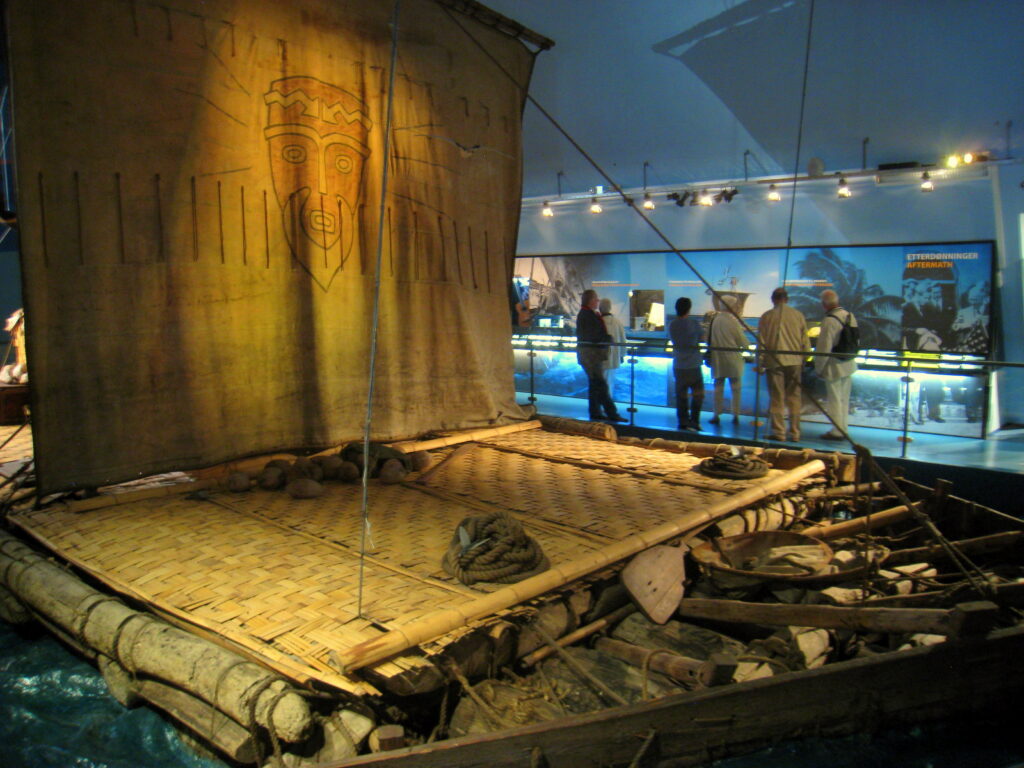
Imagine setting out across the Pacific Ocean on a raft made from nine balsa logs, with five companions, a small bamboo cabin, and thousands of miles of open water ahead. No modern yacht. No metal fastenings. No guarantee that you would ever reach the other side.
It sounds like the setup for an adventure movie, but this really happened.
In 1947, Norwegian explorer Thor Heyerdahl and his five-man crew sailed a handmade raft called the Kon-Tiki from Peru across the Pacific. Their voyage became one of the most celebrated exploration stories of the 20th century. It also helped inspire generations of travelers, adventurers, and fans of the South Pacific imagery that became part of America’s Tiki-era fascination.
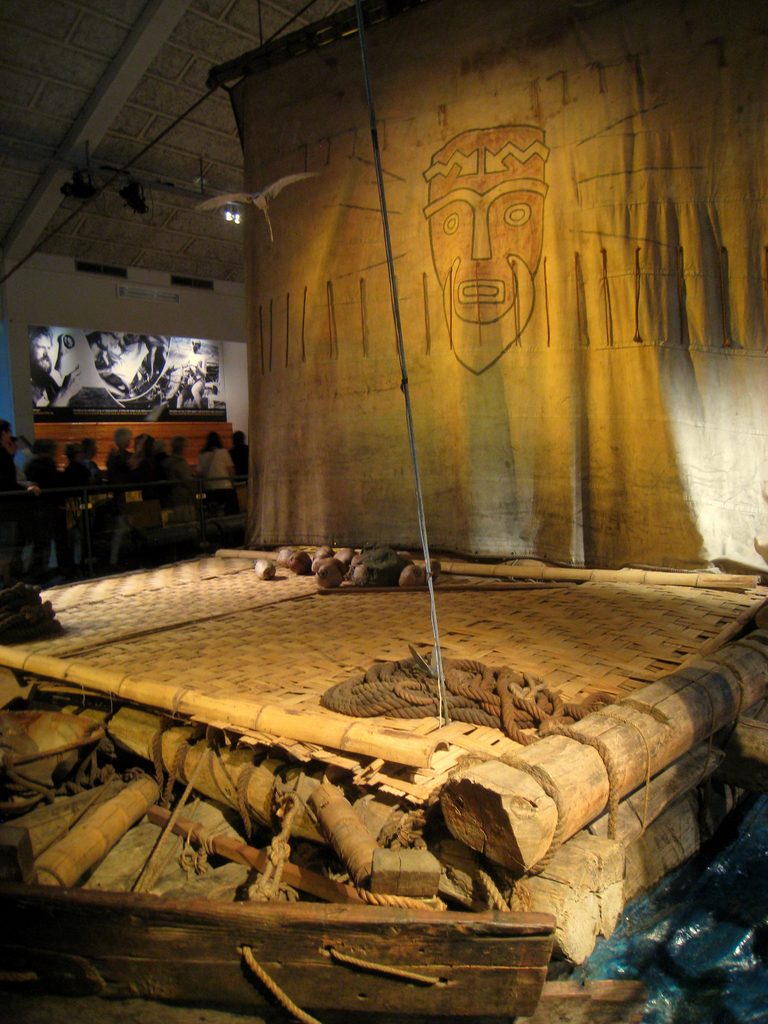
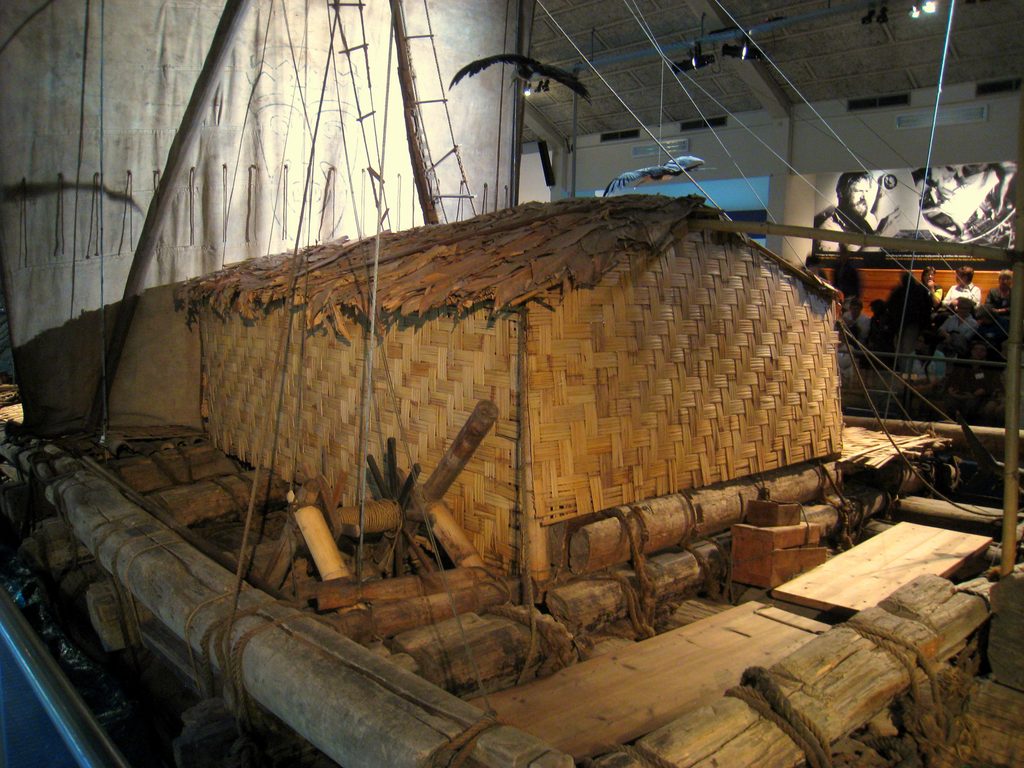
Today, the original raft is preserved at the Kon-Tiki Museum in Oslo, Norway, where visitors can stand close to the vessel that carried six men across thousands of miles of ocean.
An Idea Born in the South Pacific
The story began years before the famous voyage.
In 1937, Thor Heyerdahl traveled to Fatu Hiva in the Marquesas Islands, where he lived and studied the natural environment and local traditions. He became interested in the possibility that people from South America might have reached Polynesia by sea in ancient times.
Heyerdahl noticed that prevailing winds and ocean currents could carry vessels westward from the coast of South America toward the Pacific islands. He believed that ancient seafarers might have made such a journey using simple rafts rather than sophisticated modern ships.
His theory challenged the prevailing understanding of Polynesian settlement, which recognized the extraordinary maritime achievements of the peoples who navigated eastward from Island Southeast Asia and the western Pacific.
Heyerdahl wanted to demonstrate that a voyage from South America was possible. Rather than relying solely on argument, he decided to put the idea to a practical test.
Building the Kon-Tiki
In 1947, Heyerdahl and his team set about building a raft based on descriptions and illustrations of traditional South American vessels.
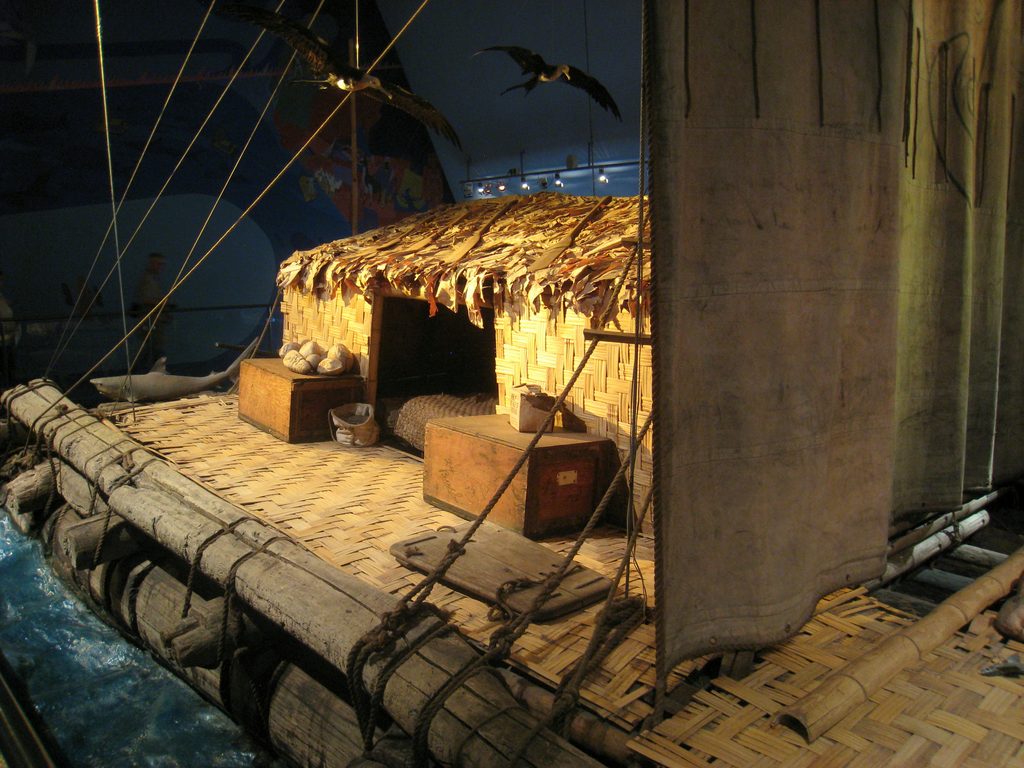
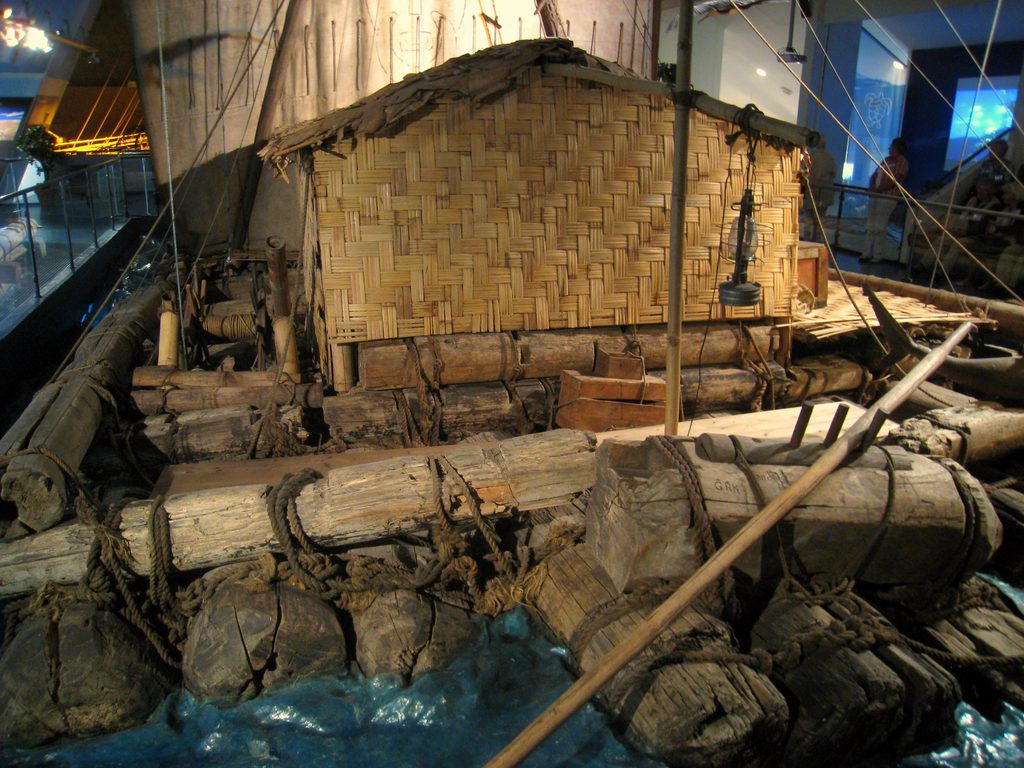
The result was the Kon-Tiki, constructed from nine large balsa-wood logs lashed together with rope. A bamboo structure provided shelter, and the raft carried a sail and other equipment needed for the journey.
The crew deliberately avoided modern metal fastenings, seeking to recreate the basic construction methods that Heyerdahl believed ancient South American seafarers could have used.
The name Kon-Tiki came from a legendary figure associated with the sun in Andean tradition, reflecting Heyerdahl’s interpretation of the ancient connections he was investigating.
The crew consisted of six men:
- Thor Heyerdahl
- Erik Hesselberg
- Bengt Danielsson
- Knut Haugland
- Torstein Raaby
- Herman Watzinger
They were about to find out what a simple wooden raft could accomplish in one of the world’s largest oceans.
101 Days Across the Pacific
On April 28, 1947, the Kon-Tiki departed from Callao, Peru.
The voyage covered more than 4,000 miles of open ocean. The crew faced changing weather, waves, long days at sea, and the constant challenges of living aboard a small raft. They documented much of the experience with cameras, capturing the adventure that would later become an internationally known film.
After 101 days, on August 7, 1947, the raft reached the Tuamotu Islands and struck a reef at Raroia. The crew survived, and the expedition had reached its destination.
The voyage demonstrated something important: a raft constructed using traditional South American techniques could make a long westward crossing of the Pacific.
But there is a distinction worth understanding. The expedition did not prove that South Americans originally settled Polynesia. It showed that such a crossing was possible under the conditions of the voyage. The question of how Polynesia was settled is much broader, and archaeological, linguistic, and genetic research has continued to develop our understanding of Pacific history.
The Kon-Tiki voyage remains an extraordinary example of experimental exploration: testing an idea by building a vessel and taking it to sea.
From a Pacific Voyage to an International Sensation
The expedition’s story did not end when the raft reached Raroia.
Heyerdahl wrote about the adventure in his book The Kon-Tiki Expedition: By Raft Across the South Seas. Published in 1948, it became an international bestseller and introduced millions of readers to the journey.
The documentary filmed during the expedition also brought the story to a much wider audience. Its authentic footage of the crew and their experiences at sea helped make the voyage feel immediate and personal. The film received the Academy Award for Best Documentary Feature in 1951.
Suddenly, the Kon-Tiki was more than a raft. It was a symbol of exploration, curiosity, and the willingness to challenge what people thought was possible.
The Kon-Tiki and the Tiki Culture Connection
Here’s where the story takes an interesting turn for fans of vintage Tiki bars, tropical cocktails, carved decor, and mid-century Polynesian Pop.
American Tiki culture did not begin with the Kon-Tiki expedition. Its roots go back to the 1930s, when establishments such as Don the Beachcomber in Hollywood began creating imaginative tropical environments inspired by the Pacific, the Caribbean, and other faraway destinations.
After World War II, American interest in travel, island settings, and exotic adventure grew. Tiki restaurants and bars became popular places to escape everyday life through tropical drinks, themed interiors, music, and a romanticized vision of the South Pacific.
The Kon-Tiki expedition arrived right in the middle of that growing fascination. Heyerdahl’s dramatic voyage from Peru to Polynesia gave audiences a real-life adventure to go along with the books, movies, music, and tropical imagery of the era.
It is important to distinguish American Tiki culture from the traditional cultures of Polynesia and other Pacific peoples. The mid-century Tiki movement was an American popular-culture creation that borrowed imagery and influences from many places. It was not a direct representation of the diverse living cultures of the Pacific.
Still, for today’s Tiki revival enthusiasts, the Kon-Tiki offers a fascinating connection to the age of exploration and the mid-century imagination that helped shape the movement.
A Museum Built Around an Extraordinary Raft
The worldwide interest in Heyerdahl’s expedition led to the creation of a museum dedicated to his work.
The Kon-Tiki Museum opened in Oslo on May 15, 1950, in a small temporary wooden building. The original raft attracted so much attention that a larger, permanent home was needed. The permanent building was completed in 1956, and the museum moved into its current premises in 1957.
Located on Oslo’s Bygdøy peninsula, the museum preserves the original Kon-Tiki raft and tells the story of Heyerdahl’s many expeditions.
Visitors can also see Ra II, the papyrus-reed boat Heyerdahl and his crew sailed across the Atlantic in 1970. Other exhibitions explore his journeys to Fatu Hiva, the Galápagos Islands, Easter Island (Rapa Nui), and beyond.
Among the museum’s other attractions are an underwater exhibition featuring models of sharks and fish, and a 30-meter-long replica cave inspired by caves on Easter Island.
The museum also screens the original Kon-Tiki documentary, allowing visitors to experience footage from the voyage itself.
For anyone interested in exploration, maritime history, anthropology, or the mid-century fascination with faraway places, this is a remarkable collection.
Planning a Visit to the Kon-Tiki Museum
If Oslo is on your travel itinerary, the Kon-Tiki Museum is a worthwhile stop—especially if you enjoy the stories behind famous expeditions.
Kon-Tiki Museum
Bygdøy, Oslo, Norway
Official website: https://www.kon-tiki.no/en/home
The museum’s website provides current visitor information, opening hours, ticket details, and information about its exhibitions. Check it before visiting, as schedules and admission details can change.
And if you’re a Tiki enthusiast, a visit offers something a little different from the usual bar, cocktail, or vintage decor tour: a chance to see the actual raft behind one of the great adventure stories of the 20th century.
A Little Curiosity Goes a Long Way
The Kon-Tiki voyage reminds us that exploration isn’t always about having the newest equipment or the most sophisticated technology. Sometimes it begins with a question, a bold idea, and a willingness to test what others think cannot be done.
Six men set out from Peru on a raft built from balsa logs. More than 100 days later, they had crossed thousands of miles of Pacific Ocean and captured the world’s imagination.
That’s quite a story—and the best part is that the raft is still there to see.

Live the Life Less Traveled. Stay Curious.