
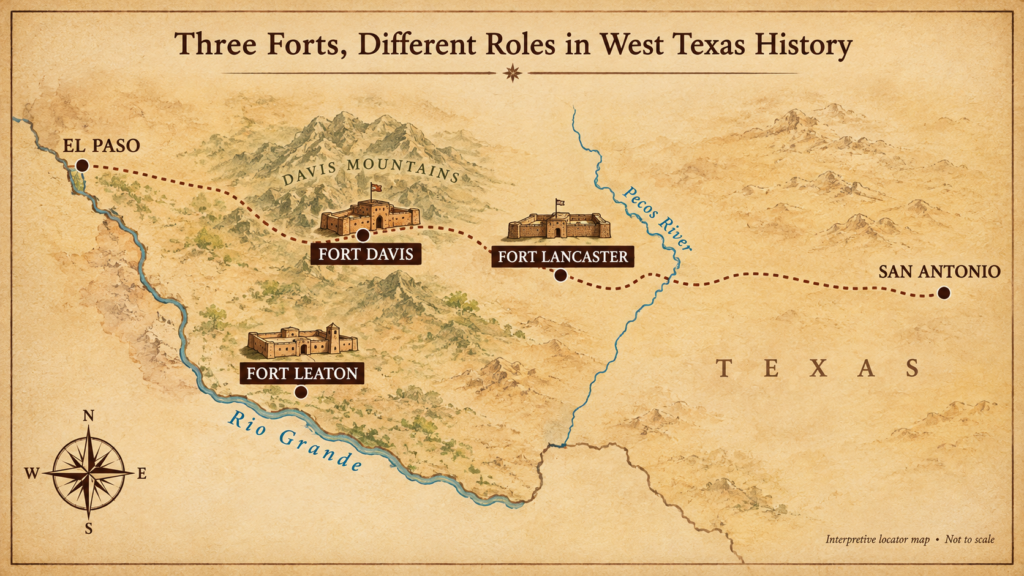
Imagine crossing West Texas in the mid-1800s. The landscape stretches for miles, water can be difficult to find, and a journey between settlements can take days or even weeks. There are no modern highways, roadside restaurants, or convenient places to stop for supplies.
For travelers, traders, mail carriers, and soldiers, making that journey could be an adventure—and sometimes a dangerous one.
During this period, military posts and fortified stopping places played important roles in the development of West Texas. Some protected travelers and military routes, while others served as places to trade, obtain supplies, and find shelter in a challenging landscape.
Three fascinating historic sites help tell this story: Fort Davis, Fort Lancaster, and Fort Leaton. Although they shared the frontier world of the 19th century, each had a different purpose and a story of its own.
Join Curious Perro as we explore these three remarkable places and discover what they reveal about the people who traveled, worked, traded, and served along the West Texas frontier.
Fort Davis: Protecting the Road West
Established by the U.S. Army in 1854, Fort Davis became an important military post in the Trans-Pecos region. Its location in the Davis Mountains helped the Army protect travelers, mail coaches, and freight wagons moving along the San Antonio–El Paso Road.
Life at a remote frontier post was demanding. Soldiers faced isolation, difficult terrain, harsh weather, and the logistical challenge of keeping people and supplies moving across a vast region.
The fort was abandoned during the Civil War period and reoccupied by the Army in 1867. Its later history is closely associated with the Buffalo Soldiers, Black cavalry and infantry regiments who served at western military posts after the Civil War.
Today, Fort Davis National Historic Site preserves a remarkable collection of historic buildings and ruins. Walking through the grounds offers a glimpse into military life and the people who helped shape the region’s history.
Fort Lancaster: An Outpost on the Frontier
Established in 1855, Fort Lancaster occupied a strategic position near the Pecos River, where travelers faced the challenges of crossing an important natural obstacle along the western route.
Like other frontier posts, Fort Lancaster helped protect travel and communications while providing a military presence in a remote part of Texas. Its isolated setting also made daily life difficult for the soldiers stationed there.
One of the more unusual chapters in its history involves the Army’s experiments with camels as a means of transporting supplies across the Southwest. The animals were considered for their ability to carry heavy loads through dry country, although the experiment never became a lasting part of Army transportation.
Fort Lancaster’s history also includes an attack in 1867, when Buffalo Soldiers of the 9th Cavalry defended the post.
Today, the surviving ruins provide a powerful sense of the scale of the original installation and the challenges of maintaining a military outpost far from established settlements.
Fort Leaton: A Different Kind of Frontier Fort
Fort Leaton offers an important twist in this story. Despite its name and fortified appearance, it was not primarily a U.S. Army post.
Built in the late 1840s by Ben Leaton and his wife, Juana Pedrasa, the fortified adobe complex served as a trading post near present-day Presidio, close to the Rio Grande and the Mexican border.
The surrounding region was connected to trade routes linking communities in Texas and Chihuahua. Travelers and traders needed supplies, shelter, and places to conduct business, making fortified commercial establishments valuable in this challenging environment.
Fort Leaton’s thick adobe walls and enclosed courtyard reflect the need for security in a region shaped by commerce, cultural encounters, and conflict.
Today, Fort Leaton State Historic Site preserves this distinctive piece of borderlands history. Its story reminds us that the West Texas frontier was about much more than military campaigns. It was also a place where families, merchants, and travelers built lives and pursued opportunities.
Three Places, One Larger Story
Fort Davis, Fort Lancaster, and Fort Leaton are connected by the broader history of travel and settlement across West Texas, but they did not all serve the same purpose.
Fort Davis and Fort Lancaster were U.S. Army installations associated with protecting travelers and maintaining a military presence along important routes. Fort Leaton, by contrast, developed as a fortified trading post serving the commercial life of the borderlands.
Together, these sites help us understand how military activity, transportation, trade, and settlement overlapped during the 19th century.
An especially interesting resource is an 1865-era manuscript map titled Best Route for the Movements of Troops from San Antonio to El Paso, Texas. The map documents roads, rivers, waterholes, towns, forts, and other features that mattered to people moving across the region.
Looking at a historic map alongside the surviving sites gives us another way to imagine the challenges of traveling through this landscape more than 160 years ago.
Exploring West Texas Through Its History
One of the best things about visiting historic places is discovering that the story is often more complicated—and more interesting—than the name on a sign might suggest.
A military fort, a collection of ruins, and a fortified trading post may appear similar at first glance. But each reveals a different part of the story of West Texas.
Fort Davis introduces us to military life and the Buffalo Soldiers. Fort Lancaster reveals the importance of remote outposts, river crossings, and frontier transportation. Fort Leaton brings us into the world of trade and daily life along the Texas–Mexico border.
Together, they offer three different perspectives on the people and places that shaped this part of Texas.
At Curious Perro, the fun is in looking beyond the obvious, asking questions, and discovering the stories that make a place worth exploring.
And that leaves us with a question: If you could visit just one of these three historic sites, which would you choose?
Until the next adventure, stay curious!