
Before Phoenix-Mesa Gateway Airport…
Before ASU Polytechnic…
Before the East Valley became one of the fastest-growing parts of metropolitan Phoenix…
There was Williams Field.
And looking at these old photographs, it’s hard to imagine just how important this place would become to Arizona.
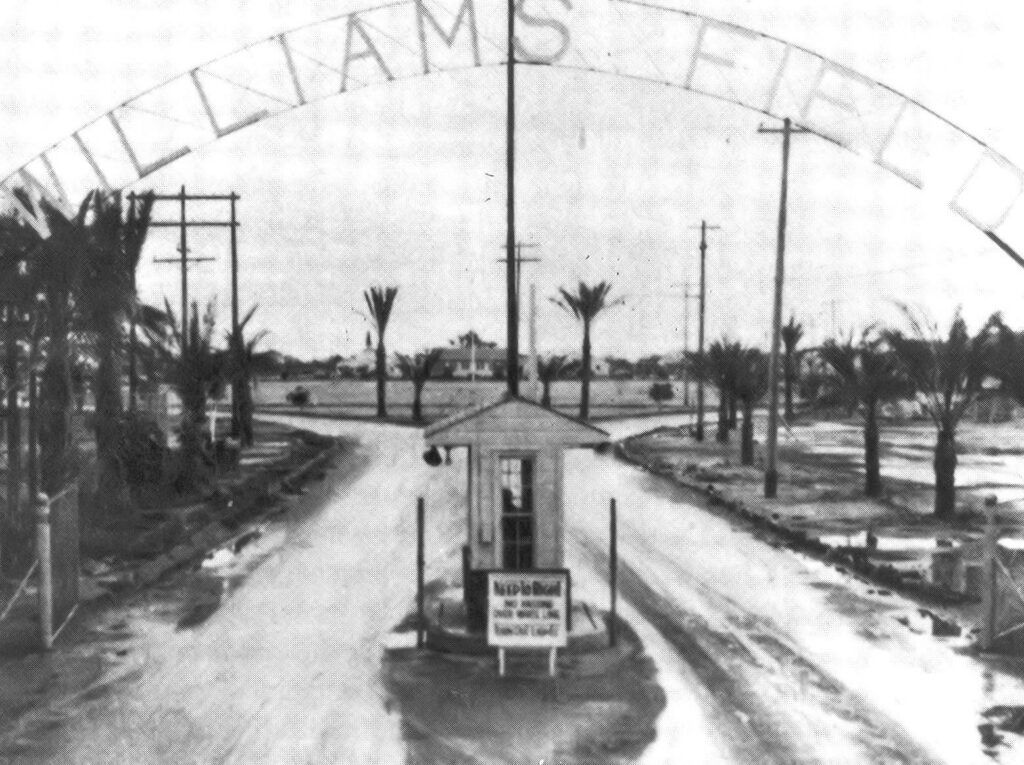
The first photograph shows an entrance to the base.
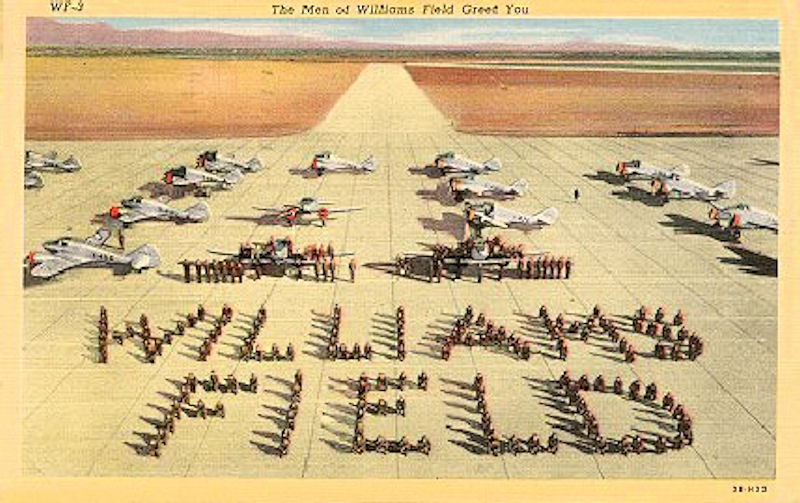
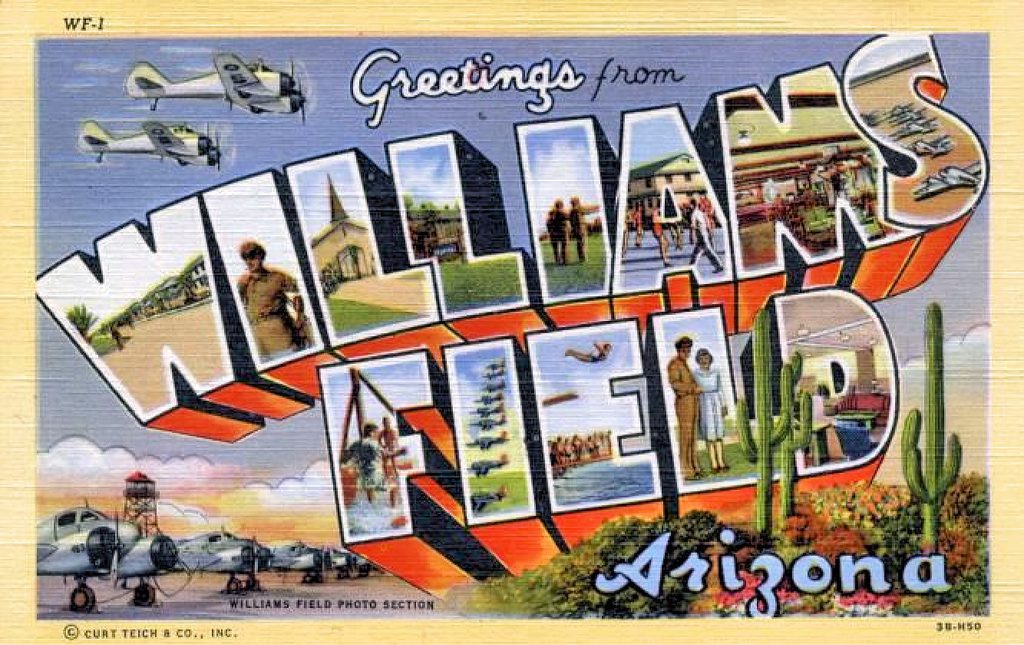
The other two are old postcards from a very different era.
But together, they tell a story about war, aviation, jobs, education, and the growth of the East Valley.
It Started in 1941
On July 16, 1941, the U.S. Army Air Corps broke ground for an Advanced Flying School in southeast Mesa.
The location made sense.
Arizona offered wide-open desert, relatively clear skies, and plenty of room for flight training.
And the timing couldn’t have been more important.
America was preparing for the possibility of war.
The facility first operated as Mesa Military Airport and was briefly known as Higley Field.
In February 1942, it became Williams Field, named after Arizona-born pilot 1st Lt. Charles Linton Williams, who died in a 1927 aircraft accident in Hawaii.
Then came World War II.
Williams became a major training center for military pilots.
Thousands of men trained here before heading into one of the largest conflicts the world had ever seen.
From Williams Field to Williams Air Force Base
In 1948, the facility became Williams Air Force Base.
And its importance only grew.
For more than five decades, Williams trained pilots for the United States Air Force.
In fact, it became the Air Force’s foremost pilot-training facility.
More than 26,500 men and women earned their wings at Williams during its military history.
At its height, the base supplied roughly 25% of the Air Force’s pilots each year.
Think about that.
Some of the pilots who learned to fly here would eventually fly military aircraft around the world.
And while those pilots were training, something else was happening on the ground.
Mesa was growing.
A Base Changes a Community
Military bases don’t exist in isolation.
They bring people.
People need homes.
They need restaurants, stores, gas stations, schools, services and transportation.
They create jobs and attract businesses.
And Williams became an important economic engine for the communities surrounding it.
Over the decades, the area around the base changed dramatically.
What had once been largely open desert was becoming part of a growing East Valley.
Then, in 1991, the base was recommended for closure through the federal Base Realignment and Closure program.
Williams Air Force Base officially closed in September 1993.
And that could have been the end of the story.
But Arizona had another idea.
From Military Base to Gateway
Instead of allowing thousands of acres of developed land and aviation infrastructure to simply disappear, local leaders developed a plan to reuse the property.
In March 1994, the former base reopened as Williams Gateway Airport.
Today, we know it as Phoenix-Mesa Gateway Airport.
But the transformation went far beyond an airport.
Parts of the former Williams base became an educational and research campus, including what is now Arizona State University’s Polytechnic campus and Chandler-Gilbert Community College.
The former military property also became home to aviation companies and other businesses.
In other words…
The mission changed, but aviation never really left.
Look at the East Valley Today
Drive through southeast Mesa, Gilbert and Queen Creek today and it’s easy to forget what was here decades ago.
Homes.
Shopping centers.
Restaurants.
Schools.
Businesses.
Technology.
Manufacturing.
And a growing regional airport.
But underneath all of that is a piece of history that helped set the stage for the East Valley’s transformation.
Williams Field was more than an airfield.
It was a place where thousands of people came to learn to fly.
It was a military installation during some of America’s most important moments.
It was a source of jobs and economic activity.
And when the military mission ended, the community found a way to give the property a new purpose.
That’s one of the things I love about old photographs.
You can look at a picture of a gate, a runway or an old postcard and think you’re simply looking at the past.
But sometimes you’re actually looking at the beginning of the future.
Today, airplanes still take off from this same piece of Arizona.
Students still study here.
Businesses still operate here.
And the East Valley continues to grow around it.
The signs may have changed.
The uniforms may be gone.
The mission is different.
But the legacy of Williams Field is still flying.
🐾✈️🌵 Live the Life Less Traveled. Stay Curious.